Δ-flip (delta flip): where SPX options flow changes sign
Updated October 26, 2026
Every option traded carries a delta: roughly how much its price moves for a one-point move in the index. Calls have positive delta, puts negative. Add up the delta of everything that traded at a strike and you get that strike's net delta.
What the Δ-flip is
Going up the strikes from below the price, net delta is usually negative at first — put activity dominates — and turns positive higher up, where calls dominate. The Δ-flip is the strike nearest the current price where that sign changes from negative to positive.
- Price above the Δ-flip: the activity around the price leans to calls.
- Price below the Δ-flip: it leans to puts.
Δ-flip vs gamma flip
You'll also see a "gamma flip" or "zero gamma" level. That one estimates where market makers' total gamma changes sign, which depends on assumptions about who is long and who is short each contract. The Δ-flip uses only what traded: the delta of each strike's volume. It's simpler and it updates as the day's flow changes.
How traders use it
- As a regime line: holding above it with calls in control reads differently from sitting below it.
- As a level: price often hesitates around the flip, the way it does around a wall.
- As a distance: how many points SPX sits from its Δ-flip says how far a move needs to go to change the picture.
Where to find it in Index Viz
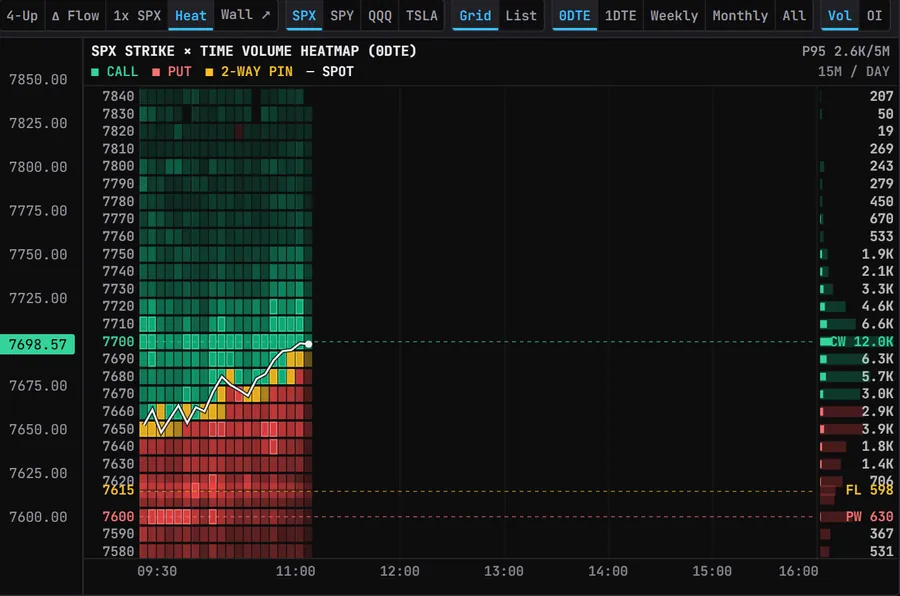
The Δ-flip is drawn on the chart and tagged FL in the options ladder and heatmap. On a phone, the state line under the header shows the distance to it, for example Δ7750 +53. It's computed for SPX, NDX, SPY, QQQ, the MAG7 composite and every S&P 500 and Nasdaq-100 stock.